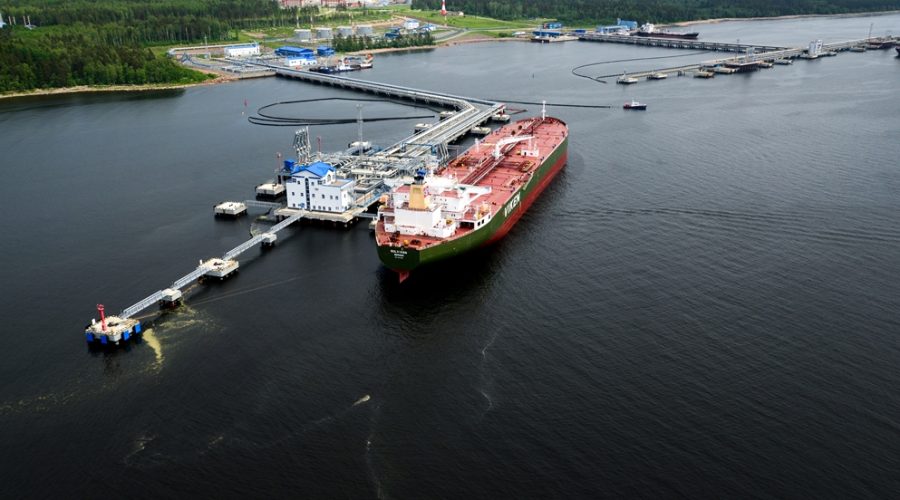
Port of Primorsk: Russia’s Baltic Oil Export Terminal
The Port of Primorsk is Russia’s largest oil export terminal and one of the most strategically important energy infrastructure facilities in the world. Located on the northern shore of the Gulf of Finland in the Leningrad Oblast of northwestern Russia, approximately 80 kilometres west of St Petersburg, it is the western terminus of the Baltic Pipeline System (BPS) – the pipeline infrastructure that carries crude oil from Russia’s West Siberian and Timan-Pechora oil fields to the Baltic Sea for export to European and international markets. Since its opening in 2001, Primorsk has handled hundreds of millions of tonnes of crude oil and has been the primary route through which Russia’s Urals blend crude oil reaches the global market.
This post covers the port’s history, the infrastructure, the construction methodology, the pipeline system, the operational performance and the strategic significance of Primorsk in the context of Russia’s energy export infrastructure and the global oil market.
Project Facts
| Item | Detail |
|---|---|
| Port name | Port of Primorsk (Приморск) |
| Location | Primorsk, Leningrad Oblast, Russia – northern shore of the Gulf of Finland |
| Distance from St Petersburg | Approximately 80 km west |
| Port type | Crude oil and petroleum products export terminal |
| Annual throughput capacity | Approximately 75–80 million tonnes per year (crude oil) |
| Pipeline system | Baltic Pipeline System (BPS-1 and BPS-2) |
| Pipeline operator | Transneft – Russia’s state-owned pipeline monopoly |
| Port operator | Primorsk Trade Port (PTP) – subsidiary of Transneft |
| Crude oil grade | Urals blend – medium sour crude (API approximately 31°, sulphur approximately 1.5%) |
| Vessel types handled | Aframax tankers (primary) – up to 120,000 DWT; Suezmax tankers at outer anchorage |
| Number of berths | Multiple crude oil loading berths |
| Crude oil storage capacity | Approximately 1.7 million cubic metres |
| Commissioned | December 2001 (first cargo) |
| BPS-1 capacity | 50 million tonnes per year |
| BPS-2 capacity | 30 million tonnes per year (additional) |
The Strategic Context – Why Primorsk Was Built
To understand the Port of Primorsk, it is necessary to understand the geopolitical and commercial context in which it was conceived and built. In the 1990s, following the collapse of the Soviet Union, Russia found itself in a deeply uncomfortable position with respect to its crude oil export infrastructure. The Soviet-era pipeline system had been designed to move oil from the West Siberian fields westward to refineries and export terminals in the Soviet republics and Eastern Europe. With the dissolution of the USSR, the key export terminals on the Baltic Sea – Ventspils in Latvia and Butinge in Lithuania – were now in independent foreign countries. The pipeline routes to these terminals crossed the territories of Ukraine, Belarus and the Baltic states – all now sovereign nations with their own interests, transit fee demands and political agendas.
Russia’s dependence on transit through foreign countries for its crude oil exports was a strategic vulnerability that the Russian government and Transneft – Russia’s state-owned pipeline monopoly – were determined to eliminate. The solution was to build a new pipeline system entirely within Russian territory, terminating at a new export terminal on Russian soil on the Gulf of Finland. That terminal was Primorsk.
The decision to build Primorsk was also driven by commercial considerations. The Ventspils terminal in Latvia was charging transit fees that Russian oil companies considered excessive. By building a competing terminal at Primorsk, Russia could reduce its dependence on Ventspils and use the threat of diverting oil flows to Primorsk as leverage in transit fee negotiations. The opening of Primorsk in 2001 effectively ended Ventspils’s role as a major Russian crude oil export terminal – Russia progressively redirected its Baltic crude oil exports to Primorsk, and Ventspils’s throughput collapsed.
The Location – Gulf of Finland
The Primorsk site on the northern shore of the Gulf of Finland was selected for the new export terminal for several reasons:
- Russian territory – the site is entirely within Russia, eliminating the transit dependency that was the primary motivation for building the terminal
- Deep water – the Gulf of Finland at Primorsk has sufficient water depth to accommodate Aframax tankers – the largest tankers that can navigate the Gulf of Finland – without dredging
- Ice conditions – the Gulf of Finland freezes in winter, but the Primorsk area is served by icebreakers that keep the shipping lanes open year-round, ensuring that the terminal can operate in all seasons
- Pipeline route – the route from the existing pipeline network to Primorsk was technically feasible and could be constructed within Russian territory
- Proximity to St Petersburg – the proximity to Russia’s second-largest city provided access to the engineering, construction and operational workforce required to build and operate the terminal
The Gulf of Finland is a semi-enclosed arm of the Baltic Sea, approximately 400 kilometres long and 70–130 kilometres wide. It is one of the busiest shipping lanes in the world, connecting the ports of St Petersburg, Helsinki, Tallinn and Riga to the open Baltic Sea and the North Sea beyond. The addition of the Primorsk crude oil export traffic to the already busy Gulf of Finland shipping lanes has created significant maritime traffic management challenges, particularly in the narrow and shallow western approaches to the Gulf.
The Baltic Pipeline System (BPS)
The Port of Primorsk is the western terminus of the Baltic Pipeline System (BPS) – the pipeline infrastructure that carries crude oil from Russia’s oil fields to the Baltic Sea for export. The BPS was developed in two phases – BPS-1, commissioned in 2001, and BPS-2, commissioned in 2012 – giving a combined throughput capacity of approximately 75–80 million tonnes per year.
BPS-1
BPS-1 was the original Baltic Pipeline System, constructed between 1999 and 2001 at a cost of approximately US$450 million. It connects the existing Transneft pipeline network at Kirishi – a refining and pipeline hub approximately 100 kilometres east of St Petersburg – to the new export terminal at Primorsk. The pipeline is approximately 150 kilometres long and has a diameter of 1,020 millimetres (40 inches). It was designed with a throughput capacity of 12 million tonnes per year initially, subsequently expanded to 50 million tonnes per year through the addition of pumping stations and the expansion of the Primorsk terminal infrastructure.
The BPS-1 pipeline route crosses the Karelian Isthmus – the narrow strip of land between the Gulf of Finland and Lake Ladoga that connects the Russian mainland to the Karelian Peninsula. The Karelian Isthmus terrain is characterised by forests, lakes, rivers and wetlands, presenting significant environmental and construction challenges for the pipeline route. The pipeline crosses multiple rivers and streams, requiring horizontal directional drilling (HDD) or open-cut river crossings with protective coatings and cathodic protection systems to prevent corrosion in the wet, acidic soils of the region.
BPS-2
BPS-2 was the second phase of the Baltic Pipeline System, constructed between 2009 and 2012 at a cost of approximately US$3.5 billion. It provides an additional 30 million tonnes per year of throughput capacity, bringing the total BPS capacity to approximately 75–80 million tonnes per year. BPS-2 follows a different route from BPS-1, connecting the Unecha pipeline hub in the Bryansk Oblast – near the border with Belarus – to Primorsk via a new pipeline approximately 1,000 kilometres long.
The BPS-2 pipeline was designed to provide Russia with an additional route for exporting crude oil that bypasses Belarus entirely – reducing Russia’s dependence on the Druzhba pipeline system, which crosses Belarus and Ukraine, for its crude oil exports to Europe. The completion of BPS-2 gave Russia the ability to route a significant proportion of its crude oil exports through Primorsk without using any transit country infrastructure.
The Terminal Infrastructure
Crude Oil Storage
The Primorsk terminal has a crude oil storage capacity of approximately 1.7 million cubic metres – equivalent to approximately 10.7 million barrels. The storage tanks are large, floating-roof crude oil storage tanks constructed to API 650 standards. The floating roof – a pontoon structure that floats on the surface of the crude oil in the tank – minimises the vapour space above the oil and reduces evaporative losses and fire risk. The tanks are arranged in groups within secondary containment bunds designed to contain the full volume of the largest tank in the event of a tank failure.
The storage capacity at Primorsk provides the buffer between the continuous flow of crude oil arriving by pipeline and the batch loading of crude oil onto tankers. The pipeline delivers crude oil to the terminal at a continuous rate, while tanker loadings occur in discrete batches – a tanker arrives, loads its cargo and departs. The storage tanks absorb the difference between the continuous pipeline inflow and the batch tanker outflow, ensuring that the terminal can operate efficiently regardless of the timing of tanker arrivals and departures.
Loading Berths
The Primorsk terminal has multiple crude oil loading berths capable of accommodating Aframax tankers – the largest tankers that can navigate the Gulf of Finland. Aframax tankers have a deadweight tonnage (DWT) of approximately 80,000–120,000 tonnes and can carry approximately 600,000–900,000 barrels of crude oil per cargo. The loading rate at the Primorsk berths is approximately 10,000–15,000 cubic metres per hour, allowing an Aframax tanker to be loaded in approximately 12–18 hours.
For larger Suezmax tankers – which have a DWT of approximately 120,000–200,000 tonnes – the Primorsk terminal uses a ship-to-ship (STS) transfer operation at an outer anchorage in the Gulf of Finland. Crude oil is loaded onto Aframax tankers at the Primorsk berths and then transferred to the Suezmax tankers at the anchorage. This STS operation allows the terminal to effectively serve Suezmax tankers despite the water depth limitations of the Gulf of Finland.
Marine Infrastructure
The marine infrastructure at Primorsk includes the loading berths, the approach channel, the turning basin, the mooring dolphins and the marine loading arms. The approach channel was dredged to provide sufficient water depth for Aframax tankers to navigate safely to and from the berths. The turning basin provides the space required for tankers to manoeuvre within the terminal area. The mooring dolphins – reinforced concrete or steel structures anchored to the seabed – provide the mooring points for the tankers during loading operations.
The marine loading arms – articulated pipe systems that connect the terminal’s loading pipework to the tanker’s cargo manifold – must be designed to accommodate the range of tanker sizes and manifold configurations that call at the terminal. The loading arms must also be designed to withstand the forces imposed by the movement of the tanker in the swell and wind conditions of the Gulf of Finland, while maintaining a leak-tight connection to the tanker’s manifold throughout the loading operation.
Icebreaker Support
The Gulf of Finland freezes in winter, with ice typically forming in December and melting in April. The ice conditions at Primorsk can range from thin new ice to thick, consolidated ice that requires icebreaker assistance for tanker navigation. The Primorsk terminal operates year-round, with icebreaker support provided by the Russian icebreaker fleet to keep the approach channel and the terminal area clear of ice and to escort tankers through the ice-covered waters of the Gulf of Finland.
The icebreaker support requirement is a significant operational cost for the Primorsk terminal and a constraint on the size of tankers that can call at the terminal in winter. Aframax tankers with ice-class hull reinforcement are preferred for winter operations at Primorsk, as they can navigate in ice conditions that would be hazardous for standard tankers without ice-class reinforcement.
The Construction Methodology
The construction of the Port of Primorsk and the Baltic Pipeline System was one of the largest infrastructure projects undertaken in Russia in the post-Soviet era. The construction methodology was driven by the scale of the project, the challenging terrain and climate conditions of the Karelian Isthmus and the Gulf of Finland, and the requirement to complete the project on an aggressive schedule to meet Russia’s strategic objective of reducing its dependence on transit through foreign countries.
Pipeline Construction – BPS-1
The construction of the BPS-1 pipeline across the Karelian Isthmus involved the standard pipeline construction methodology – right-of-way clearing, trench excavation, pipe stringing, welding, coating, lowering-in and backfilling – adapted to the challenging terrain conditions of the region. The Karelian Isthmus is characterised by forests, lakes, rivers, wetlands and rocky outcrops that required specialist construction techniques at multiple locations along the pipeline route.
River and stream crossings were constructed using horizontal directional drilling (HDD) – a trenchless construction technique in which the pipeline is pulled through a pre-drilled bore beneath the river or stream bed. HDD eliminates the need to excavate the river bed and minimises the environmental impact of the crossing on the aquatic environment. For larger river crossings where HDD was not practical, open-cut crossings were used, with the pipeline protected by concrete weight coating and cathodic protection systems to prevent corrosion in the wet conditions.
Wetland crossings required specialist construction techniques to minimise the environmental impact of the pipeline construction on the sensitive wetland ecosystems of the Karelian Isthmus. Timber mats were used to provide a stable working platform for the construction equipment in soft, waterlogged ground. The pipeline was installed using a combination of conventional trenching and HDD to minimise the disturbance to the wetland vegetation and hydrology.
The pipeline welding programme – joining the individual pipe joints into a continuous pipeline – was carried out by specialist welding crews using automatic and semi-automatic welding equipment. Each weld was non-destructively tested – using radiographic or ultrasonic testing – to verify its integrity before the pipeline was lowered into the trench. The pipeline was coated with a fusion-bonded epoxy (FBE) coating and a concrete weight coating to protect it from corrosion and to provide negative buoyancy in the waterlogged soils of the Karelian Isthmus.
Terminal Construction
The construction of the Primorsk terminal involved civil, structural, mechanical, piping, electrical and instrumentation work packages across a large coastal site. The crude oil storage tanks – large, floating-roof tanks with capacities of 50,000–100,000 cubic metres each – were constructed using the standard tank construction methodology: foundation preparation, bottom plate welding, shell plate erection using the jacking method or the conventional bottom-up method, roof installation and hydrostatic testing.
The marine infrastructure – loading berths, approach channel, turning basin and mooring dolphins – required marine construction techniques including dredging, sheet piling, underwater concrete placement and the installation of marine loading arms. The dredging of the approach channel and the turning basin was carried out by specialist dredging contractors using cutter suction dredgers and trailing suction hopper dredgers. The dredged material was disposed of at approved offshore disposal sites in the Gulf of Finland.
The construction of the loading berths required the installation of large steel or reinforced concrete structures in the tidal zone of the Gulf of Finland. The berth structures must be designed to withstand the forces imposed by the mooring of large Aframax tankers in the wind and swell conditions of the Gulf of Finland, as well as the ice loads imposed by the winter ice conditions. The berth structures were founded on steel piles driven into the seabed, with the pile caps and deck structures constructed using marine concrete placed by specialist marine construction contractors.
Construction Schedule – Aggressive Programme
The BPS-1 pipeline and the initial Primorsk terminal were constructed on an aggressive schedule – from the start of construction in 1999 to the loading of the first crude oil cargo in December 2001, a period of approximately 24–30 months. This schedule was driven by Russia’s strategic urgency to reduce its dependence on transit through the Baltic states and by the commercial pressure to begin generating revenue from the new export route as quickly as possible.
Achieving this schedule required the simultaneous execution of multiple construction work packages across the pipeline route and the terminal site, with careful coordination to ensure that the critical path activities – pipeline welding, terminal tank construction, marine berth construction – were completed on schedule. The construction workforce – which numbered several thousand workers at peak – was mobilised rapidly and deployed across the construction front in a carefully planned sequence.
Operational Performance
Since its opening in December 2001, the Port of Primorsk has grown rapidly to become Russia’s largest crude oil export terminal. The terminal’s throughput increased from approximately 12 million tonnes in 2002 to approximately 75–80 million tonnes per year at its peak, reflecting the progressive expansion of the BPS pipeline capacity and the terminal infrastructure. At its peak throughput, Primorsk was handling approximately 1.5 million barrels of crude oil per day – making it one of the largest crude oil export terminals in the world.
The Primorsk terminal handles approximately 400–500 tanker loadings per year at peak throughput – more than one tanker per day on average. The terminal’s operational efficiency – measured by the average time a tanker spends at the berth from arrival to departure – is a critical performance metric. Delays in tanker loading reduce the terminal’s throughput capacity and increase the demurrage costs incurred by the tanker owners and the crude oil shippers.
The Urals Blend Crude Oil
The crude oil exported through Primorsk is primarily Urals blend – Russia’s primary export crude oil grade. Urals is a medium sour crude oil with an API gravity of approximately 31° and a sulphur content of approximately 1.5%. It is produced by blending crude oils from multiple Russian oil fields – primarily in West Siberia and the Volga-Ural region – in the Transneft pipeline system. The blending occurs naturally as crude oils from different fields are commingled in the pipeline system.
Urals blend is one of the most widely traded crude oil grades in the world. It is the benchmark crude oil for the European refining market and is priced at a discount to Brent crude oil – the North Sea benchmark – reflecting its higher sulphur content and slightly lower API gravity. The discount of Urals to Brent – known as the Urals-Brent differential – is one of the most closely watched price spreads in the global oil market and is a key determinant of the profitability of European refineries that process Urals crude.
Geopolitical Significance
The Port of Primorsk has been at the centre of some of the most significant geopolitical developments in the global energy market over the past two decades. Its construction was itself a geopolitical act – a deliberate effort by Russia to reduce its dependence on transit through foreign countries for its crude oil exports. Its subsequent operation has been shaped by the evolving relationship between Russia and the European Union, the imposition of Western sanctions on Russia following the invasion of Ukraine in 2022 and the restructuring of global crude oil trade flows that has resulted from those sanctions.
The 2022 Sanctions and Their Impact
Following Russia’s invasion of Ukraine in February 2022, the European Union, the United States, the United Kingdom and other Western countries imposed sweeping sanctions on Russia’s energy sector. The EU imposed a ban on the import of Russian crude oil by sea, effective December 2022, and a ban on the import of Russian petroleum products, effective February 2023. The G7 countries also imposed a price cap on Russian crude oil – limiting the price at which Russian crude could be sold to countries using Western shipping, insurance and financial services to US$60 per barrel.
These sanctions had a profound impact on the Port of Primorsk and on Russia’s crude oil export infrastructure more broadly. The EU ban on Russian crude oil imports eliminated the European market – which had been the primary destination for Primorsk’s crude oil exports – and forced Russia to redirect its crude oil exports to alternative markets, primarily India, China and other Asian countries. This redirection required significant changes to the tanker fleet serving Primorsk – the Aframax tankers that had previously carried Urals crude to European refineries were replaced by a combination of Russian-flagged tankers, tankers from countries not subject to Western sanctions and tankers operating in the so-called “shadow fleet” that operates outside the Western-controlled shipping and insurance infrastructure.
The sanctions also affected the Urals-Brent price differential. With European buyers excluded from the market and Russian crude forced to travel longer distances to Asian buyers, the Urals discount to Brent widened significantly – at times exceeding US$30 per barrel – reflecting the additional transportation costs and the reduced competition among buyers for Russian crude.
Environmental Considerations
The Port of Primorsk operates in the environmentally sensitive Gulf of Finland – a semi-enclosed sea that is particularly vulnerable to oil pollution because of its limited water exchange with the open Baltic Sea and its shallow depth. An oil spill at Primorsk – from a tanker collision, a loading arm failure or a storage tank rupture – could have severe consequences for the marine environment of the Gulf of Finland, including the coastal ecosystems of Finland, Estonia and Russia.
The terminal operates under a comprehensive oil spill response plan that includes oil spill response vessels, booms, skimmers and other containment and recovery equipment pre-positioned at the terminal. The Russian maritime authorities maintain icebreakers and oil spill response vessels in the Gulf of Finland to respond to incidents involving tankers navigating to and from Primorsk.
The high volume of tanker traffic in the Gulf of Finland – generated by Primorsk and the other ports in the region – has been a source of concern for the environmental authorities of Finland and Estonia, whose coastlines would be affected by a major oil spill. The Helsinki Commission (HELCOM) – the intergovernmental body responsible for the protection of the Baltic Sea marine environment – has worked with Russia and the other Baltic Sea states to develop traffic separation schemes, vessel traffic management systems and oil spill response capabilities to reduce the risk of a major oil spill in the Gulf of Finland.
Summary
The Port of Primorsk is Russia’s largest crude oil export terminal and one of the most strategically important energy infrastructure facilities in the world. Located on the northern shore of the Gulf of Finland, approximately 80 kilometres west of St Petersburg, it is the western terminus of the Baltic Pipeline System and the primary route through which Russia’s Urals blend crude oil reaches the global market. Built between 1999 and 2001 on an aggressive schedule driven by Russia’s strategic objective of reducing its dependence on transit through foreign countries, it has grown from an initial throughput of 12 million tonnes per year to approximately 75–80 million tonnes per year at its peak. The imposition of Western sanctions on Russia’s energy sector following the 2022 invasion of Ukraine has fundamentally changed the market for Primorsk’s crude oil exports, forcing a redirection of flows from European to Asian markets and a restructuring of the tanker fleet serving the terminal. The key facts are:
- Location – Primorsk, Leningrad Oblast, Russia – northern shore of the Gulf of Finland, approximately 80 km west of St Petersburg
- Port type – crude oil and petroleum products export terminal
- Annual throughput capacity – approximately 75–80 million tonnes per year
- Pipeline system – Baltic Pipeline System (BPS-1 and BPS-2) – operated by Transneft
- BPS-1 capacity – 50 million tonnes per year – commissioned 2001
- BPS-2 capacity – 30 million tonnes per year additional – commissioned 2012
- Crude oil grade – Urals blend – medium sour – API approximately 31°, sulphur approximately 1.5%
- Vessel types – Aframax tankers (primary) – Suezmax via STS transfer at outer anchorage
- Crude oil storage capacity – approximately 1.7 million cubic metres
- Commissioned – December 2001 – first crude oil cargo
- Operator – Primorsk Trade Port (PTP) – subsidiary of Transneft
- Built to eliminate Russia’s dependence on transit through Latvia, Lithuania, Belarus and Ukraine for Baltic crude oil exports
- Profoundly affected by Western sanctions imposed following Russia’s 2022 invasion of Ukraine
Interested in Oil Terminal or Pipeline Construction Methodology?
We work with contractors, owners and project teams on construction methodology, programme development and Efficient Construction Cost (ECC) modelling for crude oil terminals, petroleum product terminals, pipeline systems and marine infrastructure projects. Our approach starts with the construction methodology – and builds the programme and cost model from there.
Use the form below to discuss your project.
The content on PossessionPlanning.com is for informational purposes only. We make no guarantees regarding completeness or reliability. PossessionPlanning.com is an independent platform, not affiliated with or endorsed by any
rail
operator or government agency. Read our
Terms of Use.
// RESOURCES & REFERENCES
// OUR PARTNERS & NETWORK
// SUPPORT OUR MISSION
✨ Help us continue building tools that simplify complexity!
Every contribution fuels new features and improvements.


Thank you for being part of our journey! 🚀
// CONTACT US
Discover more from Construction Methodology
Subscribe to get the latest posts sent to your email.
Discover more from Construction Methodology
Subscribe to get the latest posts sent to your email.