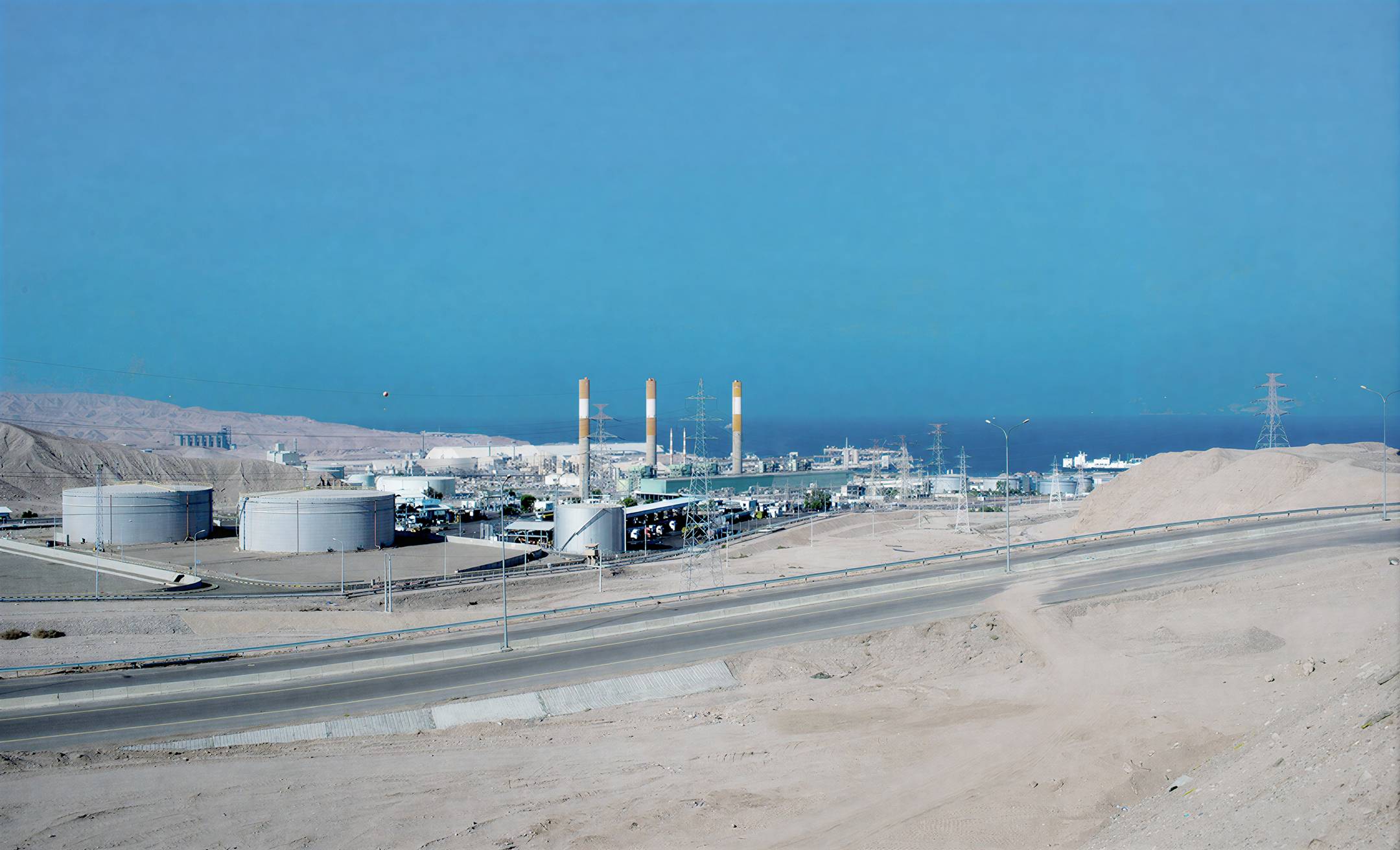
Aqaba Thermal Power Plant: Jordan’s Southern Powerhouse
The Aqaba Thermal Power Station (ATPS) is one of Jordan’s most strategically important power generation facilities. Located in the industrial zone of southern Jordan, approximately 22 kilometres south of the city of Aqaba and just one kilometre from the Red Sea, the plant comprises three steam turbine units with a combined installed capacity of 390 MW. It has been supplying electricity to Jordan’s national grid since 2000 under a Build-Own-Operate (BOO) structure, with ACWA Power holding a 40.93% stake in the project company, CEGCO.
This post covers the project facts, the technology, the construction methodology, the fuel strategy, the ownership structure and what the Aqaba Thermal Power Station represents in the context of Jordan’s energy sector and ACWA Power’s regional portfolio.
Project Facts
| Item | Detail |
|---|---|
| Location | Industrial Area, Aqaba, Jordan – approximately 22 km south of Aqaba city, 1 km from the Red Sea |
| Elevation | Approximately 35 metres above sea level |
| Technology | Steam turbine (thermal) |
| Number of units | 3 |
| Capacity per unit | 130 MW nominal gross |
| Total installed capacity | 390 MW |
| Primary fuel | Natural gas |
| Secondary fuel | Heavy fuel oil (HFO) |
| Offtaker | National Electric Power Company (NEPCO) |
| Offtake contract | BOO – Power Purchase Agreement (PPA) until 2025 |
| Project cost | US$517 million |
| Commercial operations date | 2000 |
| Project company | CEGCO (Central Electricity Generating Company) |
| O&M company | CEGCO |
| EPC contractor | ABB PGL |
| ACWA Power share | 40.93% |
| Other investors | Government Investment Management Co. LLC; Social Security Corporation |
The Site
The Aqaba site was selected for the thermal power station for reasons that are directly connected to the construction methodology and the operational requirements of a large thermal plant. The industrial zone south of Aqaba offered several critical advantages.
The proximity to the Red Sea – just one kilometre – provides access to seawater for cooling. Steam turbine power plants require large quantities of cooling water to condense the steam exhausted from the turbines back into water for reuse in the steam cycle. Once-through seawater cooling is the most efficient cooling method for a coastal thermal plant and eliminates the need for large cooling towers. The Red Sea provides a reliable, high-volume cooling water source that is essential to the plant’s thermal efficiency and operational reliability.
The location in an established industrial zone simplified the permitting process, provided access to the infrastructure – roads, utilities, communications – required for construction and operation, and placed the plant in a zone where its industrial character was compatible with surrounding land uses. The elevation of approximately 35 metres above sea level provides protection against coastal flooding while remaining close enough to the sea for the cooling water intake and outfall infrastructure to be practical and cost-effective.
The proximity to the port of Aqaba – Jordan’s only seaport – was also significant for the construction methodology. The major plant components – steam turbines, generators, boilers, transformers and other heavy equipment – were delivered by sea to the port of Aqaba and transported by road to the site. The short distance between the port and the site minimised the complexity and cost of the heavy transport operations.
The Technology
Steam Turbine Generation
The Aqaba Thermal Power Station uses conventional steam turbine technology – one of the most proven and reliable power generation technologies in the world. In a steam turbine power plant, fuel is burned in a boiler to produce high-pressure, high-temperature steam. The steam is expanded through a turbine, converting its thermal energy into mechanical energy. The turbine drives a generator that converts the mechanical energy into electrical energy. The exhaust steam from the turbine is condensed back into water in a condenser and returned to the boiler to repeat the cycle.
Each of the three units at Aqaba has a nominal gross capacity of 130 MW, giving a total installed capacity of 390 MW. The three-unit configuration provides operational flexibility – units can be taken offline for maintenance without losing the full plant output – and redundancy, ensuring that the plant can continue to supply power to the grid even when one unit is unavailable.
Dual-Fuel Capability
The plant is designed to operate on natural gas as the primary fuel and heavy fuel oil (HFO) as the secondary fuel. This dual-fuel capability is a critical feature of the plant’s design in the context of Jordan’s energy supply situation. Jordan has limited domestic energy resources and is heavily dependent on imported fuel. The country’s gas supply has historically been vulnerable to disruption – most notably the repeated attacks on the Arab Gas Pipeline from Egypt in the early 2010s, which forced Jordan to switch to more expensive HFO and diesel generation for extended periods.
The ability to switch between natural gas and HFO gives the plant – and Jordan’s grid operator, NEPCO – the flexibility to manage fuel supply disruptions without losing generation capacity. When natural gas is available and affordable, the plant operates on gas, which is cleaner and more efficient. When gas supply is disrupted or gas prices are high, the plant can switch to HFO, maintaining generation continuity at the cost of higher fuel costs and higher emissions.
EPC Contractor – ABB PGL
The plant was designed, procured and constructed by ABB PGL under an EPC contract. ABB is one of the world’s leading power and automation technology companies, with extensive experience in the design and construction of thermal power plants. The EPC contract placed the responsibility for the design, procurement, construction and commissioning of the plant with a single contractor, providing the project company with a single point of accountability for the delivery of the plant to the specified performance standards.
The Construction Methodology
The construction of a 390 MW thermal power station is a complex, multi-discipline programme that requires the integration of civil, structural, mechanical, electrical and instrumentation and control (I&C) work packages across a site that is active with multiple contractors and subcontractors simultaneously. The construction methodology for the Aqaba plant was driven by the EPC contract structure, the site conditions and the performance requirements of the plant.
Civil and Structural Works
The civil and structural works at Aqaba included the turbine hall foundations, the boiler house structures, the cooling water intake and outfall structures, the fuel oil storage and handling facilities, the electrical switchyard and the site infrastructure. The turbine hall and boiler house are the largest and most complex civil structures on a thermal power plant site. They must be designed and constructed to support the weight of the heavy plant – steam turbines, generators, boilers and their associated pipework and equipment – and to provide the structural stability required for the precise alignment of rotating machinery.
The cooling water intake structure – located at the Red Sea shoreline – required marine construction techniques. The intake structure must be designed to draw seawater at the required flow rate while preventing marine organisms, debris and sediment from entering the cooling water system. The outfall structure returns the warmed cooling water to the sea at a controlled temperature and location to minimise the environmental impact of the thermal discharge.
Mechanical Installation
The mechanical installation at Aqaba covered the steam turbines, generators, boilers, condensers, feedwater heaters, pumps, heat exchangers, piping systems and the cooling water system. The steam turbines and generators are the most critical and most precisely installed items of plant. They must be installed on their foundations to tight alignment tolerances – typically within fractions of a millimetre – to ensure that the rotating machinery operates without vibration and achieves its design performance.
The boilers – large pressure vessels in which fuel is burned to produce steam – are among the heaviest items of plant on the site. Their installation required heavy lift cranes and careful sequencing to ensure that the boiler components were installed in the correct order and that the completed boiler assembly met the design requirements for pressure containment and thermal performance.
Electrical and I&C Installation
The electrical installation at Aqaba covered the generators, transformers, switchgear, protection systems, control systems and the grid connection. The plant connects to Jordan’s national grid through a high-voltage switchyard. The switchyard must be designed and constructed to handle the full output of the plant and to provide the protection and switching capability required for safe and reliable grid connection.
The instrumentation and control (I&C) systems are the brain of the power plant. They monitor and control every aspect of the plant’s operation – fuel supply, combustion, steam generation, turbine operation, cooling water flow and electrical output. The I&C systems must be installed, configured, tested and commissioned with extreme care. A failure in the I&C systems can cause a plant trip – an unplanned shutdown – that interrupts the supply of power to the grid and generates significant costs.
Commissioning
Commissioning a thermal power plant is a multi-stage process that begins with the completion of the civil and structural works and ends with the demonstration of the plant’s performance against the contractual performance guarantees. The commissioning process includes flushing and cleaning of all piping systems, pressure testing of all pressure-containing systems, functional testing of all mechanical and electrical systems, first fire of the boilers, first synchronisation of the generators to the grid, and performance testing to demonstrate that the plant achieves its guaranteed output and efficiency at the specified fuel conditions.
The commissioning of the three units at Aqaba was staggered – each unit was commissioned in sequence, allowing the commissioning team to apply the lessons learned from each unit to the next. The plant entered commercial operation in 2000, on schedule with the Power Purchase Agreement requirements.
The Ownership and Financial Structure
The Aqaba Thermal Power Station was developed under a Build-Own-Operate (BOO) structure – one of the standard project finance models for independent power projects (IPPs) in the Middle East and North Africa region. Under the BOO model, the project company – CEGCO – owns and operates the plant for the duration of the Power Purchase Agreement and sells the electricity output to the offtaker, NEPCO, under the terms of the PPA.
The project cost of US$517 million was financed through a combination of equity from the project sponsors and debt from international and regional lenders. The PPA with NEPCO provided the long-term revenue certainty required to support the project finance structure – lenders were willing to provide debt financing because the PPA guaranteed a revenue stream sufficient to service the debt over the loan term.
ACWA Power’s Role
ACWA Power holds a 40.93% stake in CEGCO, the project company that owns and operates the Aqaba Thermal Power Station. ACWA Power is one of the world’s leading developers, investors and operators of power generation and water desalination plants. Headquartered in Riyadh, Saudi Arabia, ACWA Power has a portfolio of projects across the Middle East, Africa, Central Asia and Southeast Asia, with a total investment value exceeding US$75 billion.
The Aqaba Thermal Power Station is one of ACWA Power’s early investments in Jordan and reflects the company’s strategy of investing in critical energy infrastructure in markets where reliable power generation is essential for economic development. ACWA Power’s mission – “Driving progress for people and the planet” – is reflected in its approach to power generation: delivering reliable, affordable electricity to the communities and economies that need it, while progressively transitioning its portfolio toward lower-carbon technologies.
The other investors in CEGCO are the Government Investment Management Co. LLC and the Social Security Corporation – both Jordanian public sector entities. This ownership structure reflects the strategic importance of the Aqaba plant to Jordan’s energy security and the involvement of the Jordanian government in ensuring that the plant was developed and has continued to operate in the national interest.
Jordan’s Energy Context
To understand the significance of the Aqaba Thermal Power Station, it is necessary to understand Jordan’s energy situation. Jordan is one of the most energy-poor countries in the Middle East. It has no significant domestic oil or gas reserves. It is almost entirely dependent on imported energy – primarily natural gas and oil products – to meet its electricity generation needs. This dependence on imported energy makes Jordan’s electricity sector highly vulnerable to fuel price volatility and supply disruptions.
The disruption of Egyptian gas supplies through the Arab Gas Pipeline between 2011 and 2014 – caused by repeated attacks on the pipeline in the Sinai Peninsula – had a severe impact on Jordan’s electricity sector. NEPCO was forced to switch from gas to more expensive HFO and diesel generation, causing the cost of electricity generation to increase dramatically and contributing to a significant deterioration in NEPCO’s financial position. The dual-fuel capability of the Aqaba plant – which allowed it to switch from gas to HFO when gas supplies were disrupted – was a critical factor in maintaining generation continuity during this period.
Jordan has responded to its energy vulnerability by pursuing an ambitious programme of energy diversification, including the development of large-scale solar and wind generation capacity, the construction of a liquefied natural gas (LNG) import terminal at Aqaba and the exploration of nuclear power. The Aqaba Thermal Power Station, while a conventional thermal plant, has played an important role in providing the reliable baseload generation that has supported Jordan’s economic development while the country has worked to diversify its energy mix.
The Plant’s Role in Jordan’s Grid
At 390 MW, the Aqaba Thermal Power Station represents a significant proportion of Jordan’s total installed generation capacity. Jordan’s total installed capacity is approximately 6,000 MW, of which thermal generation – gas and HFO – accounts for the majority. The Aqaba plant’s location in the south of the country, close to the industrial zone of Aqaba and the phosphate and potash mining operations in the region, makes it particularly important for supplying electricity to the southern part of Jordan’s grid.
The plant operates under a Power Purchase Agreement with NEPCO, Jordan’s state-owned electricity transmission and purchasing company. Under the PPA, NEPCO purchases the electricity output of the plant at agreed tariff rates. The PPA provides the revenue certainty that underpins the project finance structure and ensures that the plant’s investors receive a return on their investment over the life of the agreement.
Environmental Considerations
The Aqaba Thermal Power Station is a conventional thermal power plant and, as such, produces greenhouse gas emissions and other air pollutants during operation. The plant’s primary fuel – natural gas – produces significantly lower CO₂ emissions per unit of electricity generated than coal or HFO. When operating on natural gas, the plant’s carbon intensity is approximately 400–500 kg CO₂ per MWh – roughly half the carbon intensity of a coal-fired plant of equivalent capacity.
The plant’s cooling water system returns seawater to the Red Sea at a temperature above the intake temperature. The thermal discharge is managed through the design of the outfall structure and is monitored to ensure compliance with the environmental permit conditions. The Red Sea is a sensitive marine environment – it is one of the world’s most biodiverse coral reef ecosystems – and the management of the thermal discharge is an important environmental obligation of the plant’s operators.
The proximity of the plant to the Red Sea also creates a risk of marine pollution from fuel oil spills. The plant’s HFO storage and handling facilities are designed with secondary containment to prevent fuel oil from reaching the sea in the event of a spill. Emergency response procedures are in place to manage any spill that does occur.
ACWA Power’s Broader Portfolio
The Aqaba Thermal Power Station is one project in ACWA Power’s extensive portfolio of power generation and water desalination assets across the Middle East, Africa, Central Asia and Southeast Asia. ACWA Power’s portfolio includes some of the world’s most significant energy infrastructure projects, including:
- The Taweelah Reverse Osmosis Desalination Plant in Abu Dhabi – the world’s largest operational desalination facility at 909,200 m³/day
- The Noor Abu Dhabi Solar Plant – one of the world’s largest single-site solar photovoltaic plants at 1,177 MW
- The NEOM Green Hydrogen Project in Saudi Arabia – one of the world’s largest green hydrogen production facilities
- Multiple combined cycle gas turbine (CCGT) plants across Saudi Arabia, the UAE, Bahrain, Oman and other markets
- Large-scale wind and solar projects across South Africa, Morocco, Uzbekistan and other markets
ACWA Power’s investment in the Aqaba Thermal Power Station reflects its long-standing commitment to Jordan’s energy sector and its broader strategy of investing in critical energy infrastructure across the MENA region. As ACWA Power’s portfolio evolves toward lower-carbon technologies – solar, wind, green hydrogen and energy storage – the Aqaba plant represents the conventional thermal generation foundation on which Jordan’s energy transition is being built.
Summary
The Aqaba Thermal Power Station is a 390 MW steam turbine power plant that has been supplying electricity to Jordan’s national grid since 2000. Located in the industrial zone of southern Jordan, one kilometre from the Red Sea, it operates on natural gas as its primary fuel with heavy fuel oil as a backup, providing the dual-fuel flexibility that has been critical to Jordan’s grid stability during periods of gas supply disruption. It was built by ABB PGL under an EPC contract at a project cost of US$517 million and is owned and operated by CEGCO, in which ACWA Power holds a 40.93% stake alongside the Government Investment Management Co. LLC and the Social Security Corporation. The key facts are:
- Three steam turbine units – 130 MW each – total capacity 390 MW
- Located 22 km south of Aqaba city, 1 km from the Red Sea, at 35 m above sea level
- Primary fuel natural gas, secondary fuel HFO – dual-fuel flexibility critical to Jordan’s grid security
- Offtaker NEPCO under a BOO Power Purchase Agreement
- Project cost US$517 million – EPC contractor ABB PGL
- ACWA Power 40.93% shareholder in project company CEGCO
- In commercial operation since 2000
- A cornerstone of Jordan’s southern grid and a long-standing component of ACWA Power’s regional portfolio
Interested in Thermal Power Plant Construction Methodology or Project Finance Structures?
We work with contractors, owners and project teams on construction methodology, programme development and Efficient Construction Cost (ECC) modelling for thermal power, renewable energy and water infrastructure projects. Our approach starts with the construction methodology – and builds the programme and cost model from there.
Use the form below to discuss your project.
The content on PossessionPlanning.com is for informational purposes only. We make no guarantees regarding completeness or reliability. PossessionPlanning.com is an independent platform, not affiliated with or endorsed by any
rail
operator or government agency. Read our
Terms of Use.
// RESOURCES & REFERENCES
// OUR PARTNERS & NETWORK
// SUPPORT OUR MISSION
✨ Help us continue building tools that simplify complexity!
Every contribution fuels new features and improvements.


Thank you for being part of our journey! 🚀
// CONTACT US
Discover more from Construction Methodology
Subscribe to get the latest posts sent to your email.
Discover more from Construction Methodology
Subscribe to get the latest posts sent to your email.